
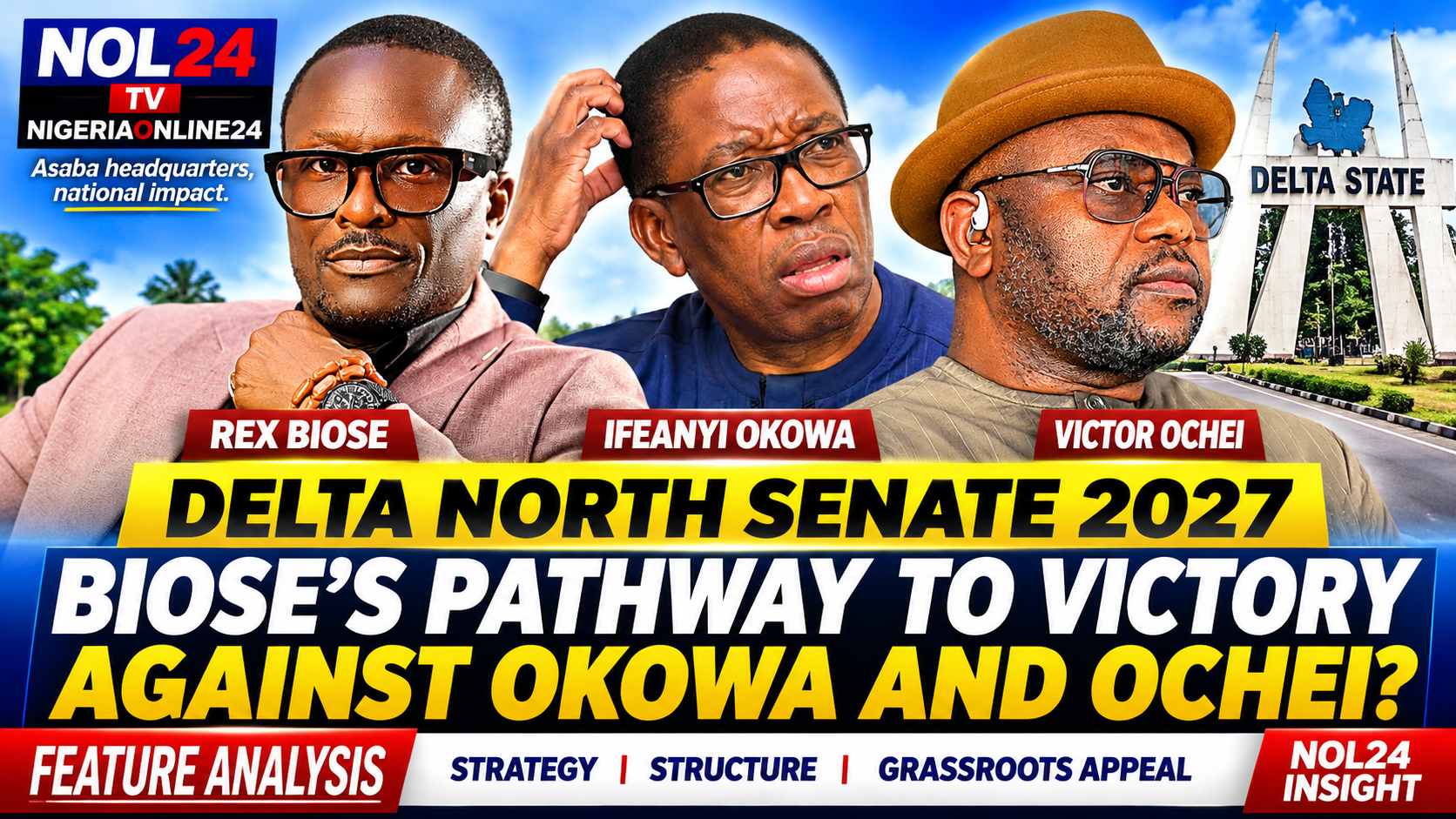
THE OBAMA MOMENT IN DELTA NORTH? Is Rex Biose Preparing to Upset the Political Establishment and Rewrite the 2027 Senate Race?


NOL24 POLITICAL ANALYSIS | ASABA, DELTA STATE
From the political establishment’s familiar calculations to an emerging politics of ideas, grassroots engagement and generational expectations, Rex Chinye Biose is introducing a different proposition into the contest for Delta North. But can an unconventional political approach overcome the machinery of established political power?
There is a moment in politics when a candidate who appears peripheral to the established power structure begins to command attention beyond what conventional political calculations would predict.
It happened in the United States in 2008.
When Barack Obama entered the Democratic presidential contest against established political figures, including Hillary Clinton, few initially considered him the obvious favourite. He lacked the traditional political machinery and establishment pedigree associated with a frontrunner.
But Obama understood something important: elections are not won exclusively through established political structures. They are also contests over ideas, public sentiment, identity, communication and the ability to inspire people who believe the existing political arrangement has little to offer them.
His message of hope, change and political renewal helped build a movement that eventually carried him to the Democratic nomination and the American presidency.
Nearly two decades later, an interesting political question is emerging in Delta North, Nigeria.
Could Rex Chinye Biose be attempting something similar in the contest for the Delta North Senatorial seat in 2027?
The comparison is not a prediction of electoral success, nor does it suggest that the political environments are identical. Rather, it offers an interesting framework for examining the strategy, messaging and political possibilities surrounding Biose’s emerging candidacy.
And there are developments worth watching.
THE ESTABLISHMENT HAS THE ADVANTAGE
Delta North is not an ordinary political constituency.
Its nine local government areas Aniocha North, Aniocha South, Oshimili North, Oshimili South, Ika North East, Ika South, Ndokwa East, Ndokwa West and Ukwuani constitute a politically significant district with established political networks and influential personalities.
The 2027 senatorial contest features candidates with substantial political backgrounds.
Former Delta State Governor, Dr Ifeanyi Okowa, has secured the APC ticket. His eight years as governor, previous experience in the Senate and extensive political relationships make him a formidable contender.
Rt. Hon. Victor Ochei, former Speaker of the Delta State House of Assembly, brings considerable legislative experience and an established political identity.
These are not political newcomers.
They possess name recognition, institutional experience and relationships developed over years of political participation.
Against this background, Biose enters the contest with a different political proposition.
A businessman, former banker and engineering consultant, he is seeking to translate his private-sector experience and political engagement into a senatorial mandate under the Labour Party.
His challenge is substantial.
But so is the political opportunity.

THE BIOSE STRATEGY: CHANGING THE CONVERSATION
One of the more interesting aspects of Biose’s political emergence is his messaging.
Rather than making his campaign exclusively about personalities, he has consistently introduced themes of competence, equity, youth participation, accountability and a different approach to representation.
His campaign expression, “Competence for a New Stride,” provides a framework for this positioning.
It attempts to move the conversation from who has occupied political office to what the next occupant should accomplish.
That distinction matters.
In an election involving established political figures, a challenger cannot necessarily compete on the same historical terrain.
The more relevant question becomes whether the challenger can introduce a new standard against which every candidate must be assessed.
Biose appears to be pursuing that political space.
His public engagement with the Equity Crusaders in Asaba, where questions of political equity, youth participation and fair representation featured prominently, illustrates this approach.
His September 2026 campaign flag-off in Issele-Uku also marked a transition from political positioning to more visible electoral engagement.
These activities suggest an attempt to build political relevance through conversations that extend beyond traditional party structures.
But political visibility is not necessarily electoral strength.
The critical test is whether these engagements translate into sustained support across all nine local government areas.
THE OBAMA CONNECTION: THE POWER OF AN UNCONVENTIONAL MESSAGE
What made Obama’s 2008 campaign particularly consequential was not simply that he was relatively young or less established than his principal opponent.
It was his ability to connect a political proposition with a broader public aspiration.
He gave people a reason to see themselves as participants in a political movement rather than spectators in an election organised by established interests.
That is the strategic lesson worth examining in the Biose campaign.
For a challenger confronting established political personalities, the most important question may not be how to reproduce the structures of the establishment.
It may be how to establish a compelling alternative.
Biose’s emphasis on competence, generational inclusion and political equity potentially speaks to constituencies interested in a different approach to political representation.
However, the Obama comparison has its limits.
Obama had a formidable grassroots organisation, a sophisticated fundraising network, a national political coalition and a disciplined campaign operation.
For Biose, the corresponding challenge is to demonstrate that his messaging can be supported by the organisational capacity required to compete across Delta North.
The message must become a movement.
And the movement must become an electoral organisation.
THE POLITICAL OPENING: ARE VOTERS READY FOR A DIFFERENT CONVERSATION?
The political dynamics of Delta North create an interesting environment for this contest.
There are longstanding questions about political equity, representation, economic opportunities, youth inclusion and the distribution of political influence.
These issues do not automatically translate into support for any particular candidate.
But they provide the context within which a challenger can introduce an alternative political argument.
Biose’s appeal to equity is particularly significant.
The question of who gets political opportunities, how representation is distributed and whether younger political actors can gain meaningful access to leadership positions has remained part of the wider Anioma political conversation.
His engagement with groups such as the Equity Crusaders and his direct engagement with electorates, suggests an awareness that political conversations around fairness and inclusion can become important components of a senatorial campaign.
Yet equity must be accompanied by a credible development agenda.
Delta North needs more than a debate about political succession.
It needs representation capable of advancing federal infrastructure, education, healthcare, agriculture, industrialisation, employment and economic opportunities.
Any candidate seeking to represent the district must explain how these priorities would translate into legislative action.
THE FIVE-POINT TEST
Biose has publicly identified five broad priorities under his proposed development agenda:
Infrastructure: Improving connectivity and addressing infrastructure deficits across communities.
Education: Expanding opportunities for young people through quality education.
Healthcare: Strengthening access to healthcare and improving public health outcomes.
Sustainable Economy: Creating opportunities for employment, enterprise and wealth generation.
Peace and Security: Promoting safer communities and an environment conducive to economic development.
These priorities address important concerns.
But the electorate will eventually need more than policy headings.
What specific federal legislation would he pursue?
Which federal institutions would he engage?
What infrastructure projects would receive priority?
How would he use Senate committees, appropriation processes and legislative oversight to advance Delta North’s interests?
And how would citizens measure his performance?
These are the questions that could distinguish a serious alternative from another campaign built around attractive political language.
THE BIGGEST CHALLENGE: CONVERTING ATTENTION INTO ELECTORAL STRENGTH
Here lies the central difficulty.
A candidate can generate attention without necessarily generating votes.
Social media conversations can create visibility without establishing grassroots structures.
Youth enthusiasm can create momentum without guaranteeing support across the different political and demographic constituencies of a senatorial district.
Delta North is politically diverse.
The interests and voting dynamics of Aniocha-Oshimili may not always mirror those of Ika or Ndokwa.
A successful senatorial campaign must therefore demonstrate an understanding of the entire district.
For Biose, the challenge is to build a political coalition that reaches beyond his immediate supporters.
That means sustained engagement with traditional institutions, community organisations, professional associations, women, young people, business groups and voters across the nine local government areas.
It also means establishing a clear distinction between campaign promises and achievable legislative responsibilities.
Most importantly, he must demonstrate that his campaign is bigger than the personality of its candidate.
A political movement that depends entirely on one individual is vulnerable.
A movement built around ideas, organisation and measurable expectations has a stronger foundation.
OKOWA AND OCHEI: THE ESTABLISHMENT WILL NOT BE A PASSIVE OBSERVER
It would be politically simplistic to assume that established political figures have lost their relevance simply because a new candidate has introduced a different message. Okowa brings executive experience, extensive political relationships and familiarity with the district’s political terrain.
Ochei brings a legislative background, political networks and experience within the Delta State Assembly.
Both have arguments to present to voters.
Their supporters will undoubtedly emphasise experience, established relationships and their respective records in public service.
The real contest, therefore, is not simply between old and new.
It is between competing ideas of representation.
Can experience deliver better results than a proposed new approach?
Can political connections translate into more effective federal representation?
Can a challenger with a different message build the institutional and electoral capacity to compete?
These are legitimate questions for the electorate.
And they deserve evidence-based answers.
THE REAL QUESTION: IS DELTA NORTH READY FOR A POLITICAL UPSET?
The 2008 Obama campaign demonstrated that established political expectations can be challenged when a candidate successfully connects a compelling message with organisation, public participation and a credible national coalition.
But political history does not repeat itself automatically.
Delta North has its own political culture, relationships, interests and electoral realities.
Biose’s emerging candidacy presents an interesting political development because it introduces a different narrative into a contest involving established political personalities.
Whether that narrative can become a district-wide electoral force remains an open question.
His strategic messaging is one component.
His grassroots engagement is another.
His capacity to build a coalition across the nine local government areas will be decisive.
And ultimately, voters will judge him alongside his opponents on credibility, competence, experience, character and the substance of their respective programmes.
NOL24 VERDICT: THE RACE MAY BE MORE OPEN THAN THE ESTABLISHMENT ASSUMES
Rex Biose may not possess the political history or institutional advantages of some of his opponents.
But political contests are not always settled by the weight of yesterday’s influence.
Sometimes, they are shaped by the strength of tomorrow’s proposition.
His campaign appears to understand that challenging established political figures requires more than announcing an ambition. It requires changing the conversation, connecting with constituencies seeking greater participation and presenting a credible alternative.
That is where the Obama analogy becomes interesting.
Not because Biose is guaranteed to replicate Obama’s political journey, but because both political narratives raise a fundamental question about the relationship between established power and the possibility of political renewal.
For Delta North, the 2027 election presents an opportunity to examine competing visions of representation.
For Biose, it presents a much more demanding test: whether an unconventional political approach can overcome the advantages of established political structures.
The question is no longer simply whether Rex Biose can attract attention. It is whether he can convert that attention into a credible, organised and district-wide electoral coalition.
If he succeeds, the political calculations in Delta North could change considerably.
If he does not, the establishment will retain its advantage.
Either way, the race deserves closer scrutiny.
The 2027 Delta North Senate contest may yet produce a political surprise.

