
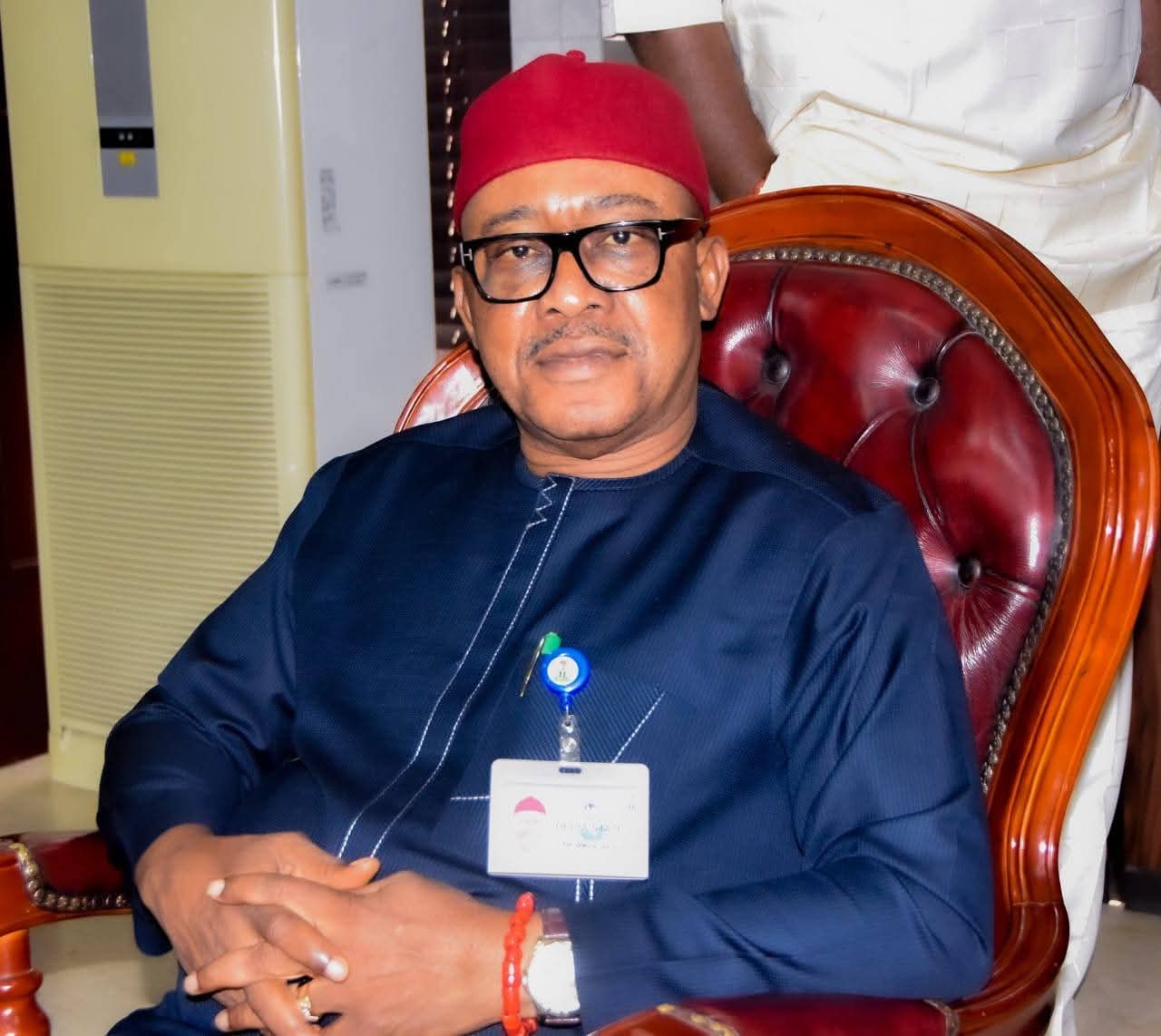
ISAAC ANWUZIA: CAN ANIOCHA SOUTH’S QUIET OPERATOR BECOME THE ARCHITECT OF A NEW ERA OF POLITICAL STABILITY?
From two terms at the local government helm to the State House of Assembly, the APC lawmaker is emerging as a central figure in the contest for power, balance and political integration in Aniocha South

From two terms at the local government helm to the State House of Assembly, the APC lawmaker is emerging as a central figure in the contest for power, balance and political integration in Aniocha South
ANIOCHA SOUTH, DELTA STATE — Peter Legacy|NOL24 POLITICAL DESK
In Aniocha South, political influence has rarely been determined by noise alone.
Behind the public rallies, political alignments and competing ambitions is a more enduring question: who has the temperament, experience and political capital to bring different interests into the same room and make them work together?
Increasingly, political attention is turning to Hon. Chief Isaac Anwuzia, the incumbent member representing Aniocha South in the Delta State House of Assembly and Chairman of Delta Mandate.
Anwuzia is not the archetypal politician who dominates every political conversation. His style is considerably more restrained. His public persona can appear almost deliberately understated.
But those familiar with his political trajectory point to a different characteristic: effectiveness without excessive theatrics.
That distinction may become particularly important as Aniocha South enters another political cycle in which questions of representation, power distribution, succession, political inclusion and local-government cohesion are becoming increasingly difficult to separate from the broader contest for influence.
For Anwuzia, the 2027 election is therefore more than a bid to return to the State House of Assembly.
It could represent the next stage of a political journey that began at the grassroots and is now positioning him for a potentially more consequential role within the state’s legislative architecture.
THE GRASSROOTS FOUNDATION
Before the State House of Assembly, Anwuzia had already occupied one of the most demanding political positions in Aniocha South: the chairmanship of the local government council.
And he did it twice.
His tenure came during a period when local governments across Nigeria faced significant financial constraints. Aniocha South was not insulated from those difficulties.
Yet, according to assessments of his administration, the limitation of resources did not prevent him from pursuing visible interventions in infrastructure and local development.
His supporters point particularly to projects undertaken during his tenure and to efforts directed at improving the physical environment of the local government.
But perhaps more significant was the security question.
At a time when insecurity could undermine economic activity and social confidence at the grassroots, Anwuzia developed a reputation as a chairman prepared to confront the challenge rather than simply manage its political consequences.
His supporters credit his administration with taking measures that helped tame insecurity and restore a greater sense of order.
It was a period in which political leadership had to operate with limited resources and competing demands.
And that experience appears to have shaped Anwuzia’s political philosophy.
Leadership, in his trajectory, seems less about possessing unlimited resources and more about determining what can be achieved with the resources available.
THE POWER OF A QUIET POLITICAL STYLE
There is an interesting paradox at the centre of Anwuzia’s political career.
He has accumulated considerable political experience without developing the profile of a politician who constantly seeks the spotlight.
That can be mistaken for weakness.
In political organisation, however, quietness and political inactivity are not necessarily the same thing.
Anwuzia’s political footprint suggests an operator who understands the value of relationships, timing and institutional positioning.
His current position as Chairman of Delta Mandate has also given him an organisational platform beyond his immediate constituency.
His political relevance, consequently, is no longer defined exclusively by his seat in the State House of Assembly.
It increasingly intersects with the larger structure of political mobilisation and alignment in Delta State.
That may explain why his name continues to feature prominently in conversations about the political future of Aniocha South.
FROM COUNCIL CHAIRMAN TO LEGISLATOR
The transition from local government chairman to legislator has given Anwuzia another dimension of political experience.
At the local government level, the political executive is expected to deliver directly to the people.
In the legislature, the responsibility is different.
A lawmaker must legislate, scrutinise government policies, represent constituency interests, participate in debates and committees, and use oversight to ensure that public institutions remain accountable.
Anwuzia’s supporters argue that he has approached this second assignment with the same determination that characterised his grassroots years.
They point to constituency interventions and projects as evidence that his representation has not been confined to the walls of the Assembly.
The argument being made on his behalf is straightforward:
He understands the grassroots because he governed there. He understands legislative politics because he now operates within it.
That combination could become one of his strongest political assets going into 2027.
THE POLITICS OF EQUITY
But perhaps the most consequential element of Anwuzia’s current political positioning is not a physical project.
It is an idea.
Equitable distribution of political power.
Anwuzia has become associated with the argument that political authority within Aniocha South must be distributed in a manner that gives the various interests and communities a legitimate sense of belonging.
This is not merely an abstract political theory.
In local politics, the distribution of positions can determine whether political actors cooperate or compete destructively; whether communities feel represented or marginalised; and whether political succession becomes a source of stability or recurring tension.
For Anwuzia, the argument appears to be that political power must be managed as a collective resource rather than treated as the permanent possession of one political tendency.
That position has gained greater visibility recently, particularly as he has reportedly pushed significant political weight behind the principle.
And therein lies a potentially important political proposition for Aniocha South.
Could political equity become the foundation for political stability?
WHY 2027 COULD BE DIFFERENT
The 2027 political cycle may demand more than the traditional politics of winning elections.
It may demand the politics of managing victory.
A candidate can win an election and still inherit a deeply fragmented political environment.
Conversely, a political leader can use electoral victory as the beginning of a broader process of reconciliation, inclusion and institutional cooperation.
This is where bookmakers and political observers who favour Anwuzia see an opportunity.
They believe his experience gives him the temperament to become an important broker between competing political interests.
His projected return to the Assembly under the APC banner could therefore have implications beyond constituency representation.
There is growing speculation that he could emerge as one of the principal officers of the Ninth Delta State House of Assembly.
If that happens, his political responsibilities would expand considerably.
The question would no longer be simply what Anwuzia can deliver to Aniocha South.
It would be what influence he can bring to bear on the wider legislative and political direction of Delta State.
THE PRINCIPAL-OFFICER QUESTION
The possibility of Anwuzia becoming a principal officer of the Ninth Assembly is one of the most interesting elements of the 2027 equation.
Principal officers are not simply ceremonial figures.
They occupy positions at the heart of legislative coordination, party management and Assembly business.
For a politician whose career has been built around grassroots administration, legislative representation and political organisation, such a position could provide a significantly larger platform.
But it would also present a test.
Could Anwuzia translate personal political capital into institutional leadership?
Could he maintain relationships across competing interests?
Could he balance the demands of his constituency with the responsibilities of state-level legislative leadership?
And, perhaps most importantly for Aniocha South, could he use an elevated position to advance a politics of inclusion rather than domination?
Those are the questions that will ultimately determine whether the current expectations surrounding him become political reality.
ANIOCHA SOUTH’S SEARCH FOR POLITICAL STABILITY
The deeper issue may not actually be Anwuzia.
It may be Aniocha South itself.
Like many politically active communities, Aniocha South has competing interests, ambitions and political blocs.
Such diversity can be a strength.
But without mechanisms for accommodation, it can also produce fragmentation.
Political stability does not mean the absence of competition.
It means competition that does not destroy the larger political community.
It means that different interests can compete for office while retaining the capacity to cooperate afterwards.
It means that political appointments and opportunities are distributed with sufficient fairness to prevent permanent exclusion.
And it means that political leaders understand that today’s opponent may become tomorrow’s ally.
This is where Anwuzia’s advocacy of equitable power distribution acquires greater significance.
If implemented through genuine consultation and cooperation, it could provide a framework for reducing political friction and broadening participation.
But the responsibility would not belong to Anwuzia alone.
No single politician can stabilise an entire local government.
It would require cooperation among elected officials, traditional institutions, community leaders, political parties, youth groups, women leaders and other stakeholders.
Anwuzia could potentially become one of the principal architects of such an arrangement.
But architecture requires more than one builder.
THE ANWUZIA PARADOX
There is therefore a fascinating paradox surrounding Isaac Anwuzia.
The politician who appears reserved may be entering one of the most consequential phases of his career.
The former council chairman who governed amid financial constraints now sits in the legislature.
The lawmaker seeking another mandate is simultaneously being discussed as a possible principal officer.
The grassroots politician is now also an organisational figure at the state level.
And the politician known for a relatively quiet public style is increasingly being associated with one of the loudest demands in local politics:
balance.
That could ultimately become his most important political asset.
Not because political balance guarantees electoral victory.
It does not.
But because political systems that survive and prosper are rarely built entirely around one individual.
They are built around relationships, accommodation and the ability to give competing interests a reason to remain within the same political tent.
2027: THE TEST OF THE THEORY
Anwuzia’s candidacy under the APC banner gives voters an opportunity to evaluate his record once again.
They will have to consider his two periods as local government chairman.
They will assess the infrastructure associated with his administrations.
They will judge his handling of security challenges.
They will scrutinise his legislative record.
They will examine his constituency interventions.
And they will listen carefully to his proposition on equitable political power.
But beyond all of these will be a larger question:
What kind of political future does Aniocha South want?
One possibility is a politics driven predominantly by individual ambition and competing political camps.
Another is a more integrated political system in which different interests negotiate power, share responsibility and work together after elections.
If the latter is what the electorate wants, Anwuzia’s political philosophy could become increasingly relevant.
But political promises are ultimately tested by political conduct.
The real measure of Anwuzia’s next chapter will therefore be whether he can turn the language of equity into a functioning political culture.
Whether he can transform relationships into cooperation.
Whether he can turn representation into broader development.
And whether a politician who has spent much of his career operating quietly can now step into a larger role without losing the consensus-building instincts that brought him this far.
THE ROAD AHEAD
The political road to 2027 will undoubtedly produce new alliances, disagreements, calculations and surprises.
For Isaac Anwuzia, however, the pathway is relatively clear.
First, defend his legislative record.
Second, secure the confidence of the electorate for another term.
Third, consolidate his standing within the APC and the wider political architecture.
Fourth, if elevated to principal-officer status, demonstrate that his legislative influence can serve both Aniocha South and the wider interests of Delta State.
And finally, make equitable political participation more than a slogan.
That is the real challenge.
Because Aniocha South does not merely need politicians who can win elections.
It needs leaders who can manage political victory responsibly.
It needs leaders capable of understanding that power distributed intelligently can create stability, while power concentrated without accommodation can create resistance.
Isaac Anwuzia’s political journey places him in an unusual position to attempt that balancing act.
He has governed locally.
He has legislated at the state level.
He has built an organisational profile.
He has survived the pressures of grassroots politics.
And he now stands at the threshold of a potentially more influential legislative role.
Whether that trajectory ultimately produces the political stability and integration many in Aniocha South desire will depend not only on Anwuzia, but on his willingness to work across political boundaries and on the willingness of other leaders to embrace the same principle.
The 2027 election may decide who occupies the seat.
The years that follow will determine what that seat was used to build.
And that may be the more important question for Aniocha South.

